The PESO model is a media classification framework developed by Gini Dietrich of Spin Sucks in 2014. It provides a structured taxonomy for organizing the full spectrum of media channels available to communicators, distinguishing them by ownership, control, and commercial relationship. The acronym stands for Paid, Earned, Shared, and Owned — four media categories that, in practice, intersect and reinforce one another rather than operate in isolation.
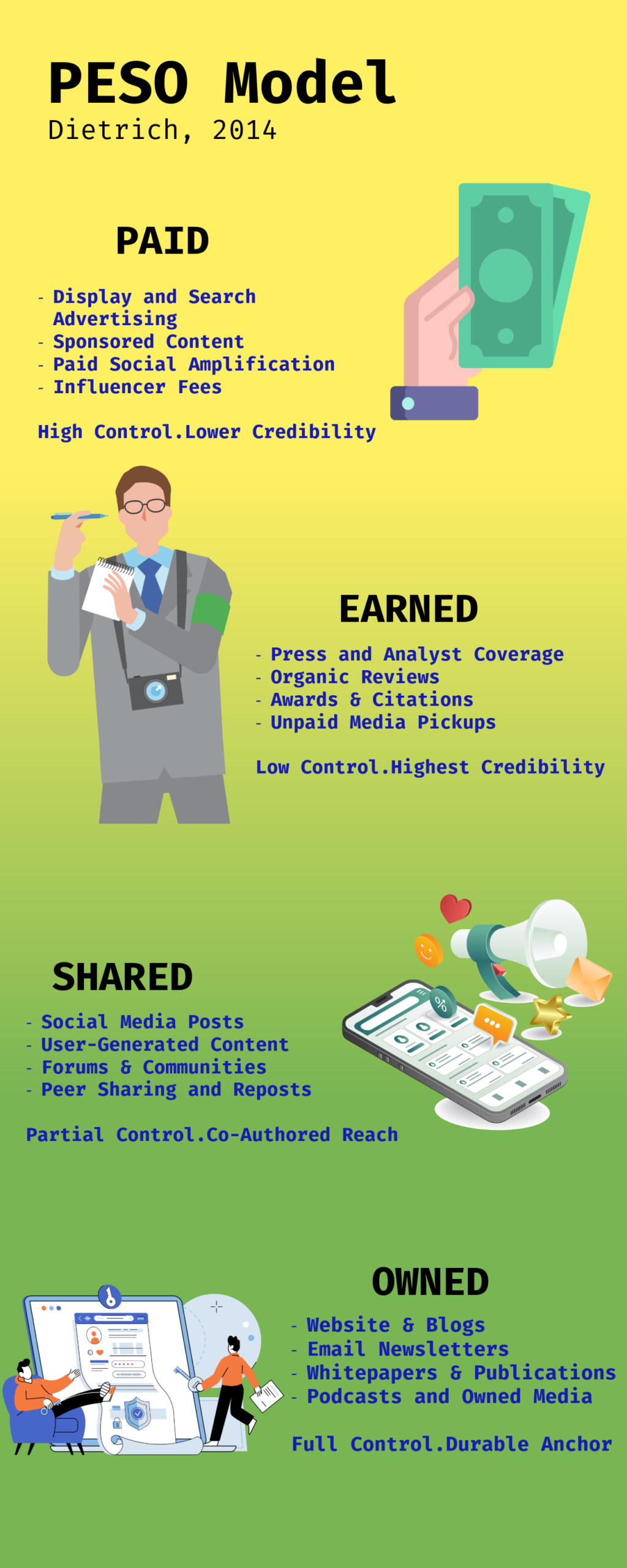
Paid media refers to any channel where distribution is purchased. This includes display advertising, sponsored content, pay-per-click campaigns, influencer partnerships with commercial arrangements, and paid social amplification. The defining characteristic is transactional control: the communicator dictates placement and message, but the audience understands (or can discern) the commercial relationship. Paid media is reliable and scalable but carries lower inherent credibility than its earned counterpart.
Earned media is coverage secured through editorial or public merit rather than payment—press coverage, analyst mentions, organic reviews, word-of-mouth, and media pickups of press releases. This category carries the highest third-party credibility, but it involves the least direct control. For reputational harm analysis, earned media is particularly significant: it is simultaneously the most credible signal of how a reputation is perceived externally and the hardest to retract once negative.
Shared media encompasses social and community-distributed content—posts on social platforms, user-generated content, community forums, and peer sharing. Crucially, shared media blurs the line between organizational voice and public amplification; the communicator initiates, but the audience co-authors reach and meaning. Social listening, monitoring, and OSINT methodologies operate primarily within this quadrant.
Owned media covers all channels that the organization directly controls: websites, blogs, email newsletters, whitepapers, podcasts, and owned publications. Owned media is the most controllable and durable channel, serving as the anchor for narrative rebalancing strategies and long-term SEO and ORM infrastructure.
The Convergence of Media Channels in the PESO Framework
Although the PESO model categorizes media into four distinct groups, real-world communications rarely remain confined to a single category. Modern information ecosystems are highly interconnected, causing content to move fluidly between paid, earned, shared, and owned channels as it gains visibility and engagement.
Consider a company that publishes a research report on its website. At the moment of publication, the report exists as owned media because the organization controls both the platform and the content. If the company distributes the report through its social media accounts, the same asset begins operating within shared media environments. Should the organization allocate advertising spend to promote the report through sponsored social posts or search advertisements, the content also enters the paid media category.
The process does not end there. Journalists, analysts, industry commentators, or members of the public may independently reference the report, generating discussion, citations, reviews, or media coverage. At that stage, the original owned asset has produced earned media outcomes, extending its reach beyond channels directly controlled by the organization.
This movement across categories illustrates one of the central insights of the PESO framework: media channels function as an integrated system rather than as isolated silos. A single piece of content may simultaneously exist within multiple PESO categories, with each channel contributing different levels of control, credibility, amplification, and audience reach.
The same dynamic applies in reputational harm scenarios. Negative coverage originating in earned media may rapidly spread through shared channels, become embedded within search results that compete with owned content, and ultimately require paid interventions to restore visibility or rebalance narratives. Understanding these interactions allows practitioners to identify not only where a reputational event originated, but also how it propagated throughout the broader information environment.
Relevance of PESO model in addressing reputational challenges
For professionals dealing with reputational challenges such as countering or quantifying reputational harm, the PESO model serves as more than a communications framework. It provides a structured method for tracing how information propagates across media ecosystems, identifying where reputational narratives originate, how they are amplified, and which channels contribute most significantly to audience exposure. Mapping reputational events through the PESO framework enables a more systematic assessment of dissemination, persistence, and potential harm.
Emerging Information Environments
While the PESO model remains a valuable framework for understanding media ecosystems, contemporary digital environments increasingly involve intermediaries that do not fit neatly within traditional media categories. Search engines, recommendation algorithms, online review platforms, collaborative knowledge repositories, and generative artificial intelligence systems now play a significant role in determining how information is discovered, interpreted, and disseminated.
Recent scholarship has suggested that these evolving environments warrant more granular classification frameworks that extend beyond the traditional PESO taxonomy. Nevertheless, many of these emerging channels continue to derive their underlying signals from paid, earned, shared, and owned media activities. As a result, PESO remains a useful foundation for analyzing information propagation and reputational dynamics, even as the broader digital ecosystem continues to evolve.