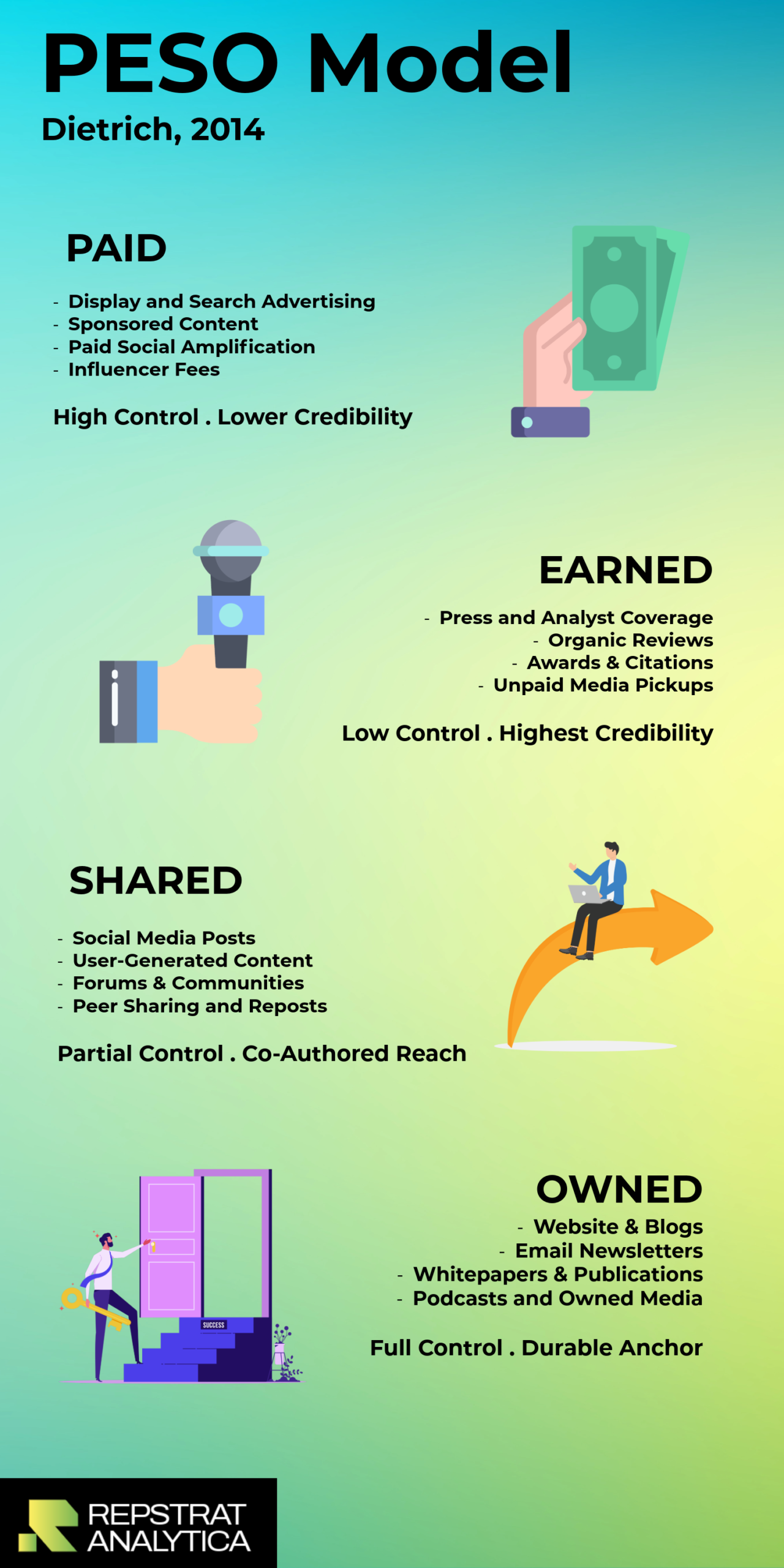
For those seeking the PESO model explained, this article provides a complete answer. The PESO model explained in its simplest form is a structured taxonomy of four media types — Paid, Earned, Shared, and Owned — that communicators use as an integrated framework. This article also provides a PESO model diagram and works through a detailed PESO model example to show how the four channels operate together in practice.
To answer the question “what is PESO model?” directly: the PESO model is a comprehensive media classification framework developed by Gini Dietrich, a communications strategist, with the publication of her book, Spin Sucks in 2014. The PESO model provides a structured taxonomy for organising the full spectrum of media channels available to communicators, distinguishing them by ownership, control, and commercial relationship. The acronym stands for Paid, Earned, Shared, and Owned media — the PESO paid earned shared owned framework — with each channel defined by a distinct relationship between the communicator, the message, and the audience.
Those asking what is PESO model explain with example will find the answer in full below. The PESO paid earned shared owned channels are four media categories that, in practice, intersect and reinforce one another rather than operate in isolation. The PESO model diagram above illustrates these overlaps visually. This article works through each of the PESO paid earned shared owned media channels individually, then presents practical PESO model examples and a crisis scenario showing the full framework in coordinated action.
PESO Model — Paid Media
Any channel where distribution is purchased — display advertising, sponsored content, PPC campaigns, influencer partnerships, and paid social amplification. Reliable and scalable, but carries lower inherent credibility than its earned counterpart.
PESO Model — Earned Media
Coverage secured through editorial or public merit — press coverage, analyst mentions, organic reviews, and media pickups. Carries the highest third-party credibility but involves the least direct control. Critical to reputational harm analysis.
PESO Model — Shared Media
Social and community-distributed content — posts on social platforms, user-generated content, and community forums. The communicator initiates, but the audience co-authors reach and meaning. Social listening and OSINT methodologies operate here.
PESO Model — Owned Media
All channels the organisation directly controls — websites, blogs, email newsletters, whitepapers, and podcasts. The most controllable and durable channel, serving as the anchor for narrative rebalancing strategies and long-term ORM infrastructure.
Paid media refers to any channel where distribution is purchased. This includes display advertising, sponsored content, pay-per-click campaigns, influencer partnerships with commercial arrangements, and paid social amplification. The defining characteristic is transactional control: the communicator dictates placement and message, but the audience understands the commercial relationship. Paid media is reliable and scalable but carries lower inherent credibility than its earned counterpart.
Earned media is coverage secured through editorial or public merit rather than payment — press coverage, analyst mentions, organic reviews, word-of-mouth, and media pickups of press releases. This category carries the highest third-party credibility, but it involves the least direct control. For reputational harm analysis, earned media is particularly significant: it is simultaneously the most credible signal of how a reputation is perceived externally and the hardest to retract once negative.
Shared media encompasses social and community-distributed content — posts on social platforms, user-generated content, community forums, and peer sharing. Crucially, shared media blurs the line between organisational voice and public amplification; the communicator initiates, but the audience co-authors reach and meaning. Social listening, monitoring, and OSINT methodologies operate primarily within this quadrant. Shared media is the overlap between paid media and owned media. Often, it represents partnerships where useful connections are forged for material considerations or mutual benefit.
Owned media covers all channels that the organisation directly controls: websites, blogs, email newsletters, whitepapers, podcasts, and owned publications. Owned media is the most controllable and durable channel, serving as the anchor for narrative rebalancing strategies and long-term SEO and ORM infrastructure. In any PESO model deployment, owned assets form the strategic foundation upon which all other channels build.
PESO Model Example: What is PESO Model — Explain with Example
The best way to understand what is PESO model explain with example is to look at concrete, real-world applications of each channel. The PESO model diagram above already shows the structural relationships; the PESO model example below brings them to life tactically. To translate the PESO paid earned shared owned definition from theory into practice, here is how the four media channels break down into everyday applications:
- Paid Media (Paying for placement):
- Search Ads: Google Ads targeting specific search queries to capture intent.
- Social Ads: Sponsored Instagram or LinkedIn videos showing product features.
- Influencer Sponsorships: Compensating a creator for a dedicated, honest product review.
- Earned Media (Third-party validation):
- Press Coverage: A journalist writing a feature about a startup’s market impact.
- Unpaid Reviews: A customer leaving an organic 5-star rating on Google or Trustpilot.
- Shared Media (Community amplification):
- Organic Social: Standard, unpaid posts on X (Twitter) or LinkedIn.
- User-Generated Content: Customers voluntarily tagging the brand in community discussions.
- Owned Media (Controlled assets):
- Websites & Blogs: Landing pages and long-form insight articles.
- Internal Documents: Proprietary whitepapers, diagnostic audits, and official corporate statements.
How Does the PESO Model Work in Crisis? A Reputational Scenario
Often, clients dealing with sudden, high-stakes crises need to see the PESO model deployed practically within the context of complex public relations. The following detailed reputational defence scenario illustrates how a multi-channel PESO model strategy operates under pressure.
Imagine X Inc., a natural gas company that suddenly becomes the target of a massive, coordinated protest campaign by activists demanding the immediate abolition of fossil fuels. Here is how X Inc. could deploy a comprehensive, multi-channel PESO model strategy to stabilise its reputation:
This synchronised PESO model execution illustrates why the framework remains foundational in crisis communications. By leveraging all four channels simultaneously, X Inc. actively educates the public and rebalances the narrative before the crisis can inflict permanent reputational harm.
PESO Model Channels: Convergence Across Media Ecosystems
Although the PESO model categorises media into four distinct groups, real-world communications rarely remain confined to a single category. The PESO paid earned shared owned channels are best understood not as separate silos but as a fluid, interconnected system. Modern information ecosystems are highly interconnected, causing content to move across the PESO paid earned shared owned quadrants as it gains visibility and engagement — a dynamic the PESO model diagram illustrates clearly.
Consider a company that publishes a research report on its website. At the moment of publication, the report exists as owned media because the organisation controls both the platform and the content. If the company distributes the report through its social media accounts, the same asset begins operating within shared media environments. Should the organisation allocate advertising spend to promote the report through sponsored social posts or search advertisements, the content also enters the paid media category.
The process does not end there. Journalists, analysts, industry commentators, or members of the public may independently reference the report, generating discussion, citations, reviews, or media coverage. At that stage, the original owned asset has produced earned media outcomes, extending its reach beyond channels directly controlled by the organisation.
This movement across categories illustrates one of the central insights of the PESO model: media channels function as an integrated system rather than as isolated silos. A single piece of content may simultaneously exist within multiple PESO model categories, with each channel contributing different levels of control, credibility, amplification, and audience reach.
The same dynamic applies in reputational harm scenarios. Negative coverage originating in earned media may rapidly spread through shared channels, become embedded within search results that compete with owned content, and ultimately require paid interventions to restore visibility or rebalance narratives. Understanding these interactions allows practitioners to identify not only where a reputational event originated, but also how it propagated throughout the broader information environment.
Relevance of the PESO Model in Addressing Reputational Challenges
For professionals dealing with complex reputation management and corporate crisis communications, the PESO model serves as more than a communications framework. It provides a structured reputational harm methodology for tracing how damaging narratives propagate across information ecosystems. By identifying where a narrative originated, how it is amplified, and which media channels contribute most significantly to public exposure, practitioners can map reputational events more effectively. Applying the PESO model taxonomy enables a systematic assessment of reputational vulnerability, helping to quantify the legal and commercial damages associated with prolonged negative media exposure.
The PESO Model in Emerging Information Environments
While the PESO model remains a valuable framework for understanding media ecosystems, contemporary digital environments increasingly involve intermediaries that do not fit neatly within traditional media categories. Search engines, recommendation algorithms, online review platforms, collaborative knowledge repositories, and generative artificial intelligence systems now play a significant role in determining how information is discovered, interpreted, and disseminated.
Recent scholarship has suggested that these evolving environments warrant more granular classification frameworks. As a result, the PESO model remains a useful foundation for analysing information propagation and reputational dynamics, even as the broader digital ecosystem continues to evolve.
Frequently Asked Questions About the PESO Model
To answer what is PESO model explain with example: the PESO model is a four-channel media framework covering Paid, Earned, Shared, and Owned media. A practical PESO model example is a product launch where the brand publishes a blog post (Owned), promotes it via Google Ads (Paid), shares it on LinkedIn (Shared), and a journalist independently covers it (Earned). Each channel plays a distinct role, and together they form the PESO paid earned shared owned integrated communications strategy.
The PESO model diagram illustrates how the four media channels — Paid, Earned, Shared, and Owned — relate to and overlap with one another. The PESO model diagram is typically represented as four intersecting segments, with shared media sitting at the overlap of paid and owned, and earned media positioned as the externally validated outcome that the other three channels can generate. The PESO model diagram is a useful reference for understanding both the taxonomy and the dynamic interactions between the PESO paid earned shared owned channels.
The PESO model acronym stands for Paid, Earned, Shared, and Owned media. Together, these four classifications represent the complete, exhaustive spectrum of media channels available for modern communications, marketing, and sophisticated public relations strategies.
The PESO model works by integrating four distinct media types into a single, unified strategy. Rather than treating advertising, public relations, social media, and corporate websites as separate silos, the PESO model ensures they intersect and amplify one another to build organisational authority, manage sentiment, and maximise audience reach.
In the PESO model, paid media includes any channel where an organisation purchases the distribution of its message. Common examples are search engine advertising (PPC), sponsored social media posts, display ads, retargeting campaigns, and paid influencer partnerships.
The PESO model was formally introduced in 2014 by communications strategist Gini Dietrich with the publication of her book, Spin Sucks, providing a modern, essential update to traditional PR channel definitions.
Imagine a company launching a new product. They write an authoritative blog post about it on their own website (Owned), pay for Google Ads to drive targeted traffic to that post (Paid), share the post on their corporate LinkedIn page to engage their followers (Shared), and a trade magazine ultimately writes an independent, unpaid review based on that launch momentum (Earned). That complete cycle is the PESO model in action.